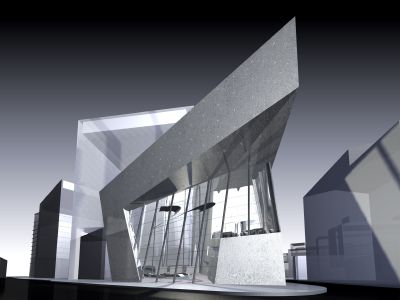
Contemporary architectural theory is at a crisis of faith. With the effective elimination of the problem of precedent and acceptable æsthetic system, architectural form has been left free of constructive constraints. With the rise and (thankful) collapse of postmodern theory and its associated ironic and heavy-handed historicisms, architectural meaning has been left free of constructive constraints as well.
On the one hand this is an especially liberating move for architectural form – indeed for the very definition of architecture, and how that definition operates in the built environment. From the halls of revered architectural institutions – Harvard, Yale, Berkeley, Columbia – comes a constant flow of radical avante-gardism, praising the liberation of architectural form and program, and raising hopes of an almost endless possibility of architectural potential.
If this liberation had been taken in earnest there might be no problem. If, in the tenuous position of the void, architectural avante-gardists had proceeded intelligently, some truly wonderful things could have developed. Some indeed have, but the vast majority of new radical architecture being produced today has a sort of bland uniformity - exactly the condition against which it is a reaction.
Across the board the rhetoric is euphoric and densely packed. Palimpsests, autonomic actions! Virtual architecture, reusable architecture, impossible architecture, bad architecture, the architecture of absense. The architecture of difference! Reactive architecture!
This development is particularly exciting. It seems, at first glance, that there is a real opportunity to engage with the consequences of contemporary philosophy and literary theory, to engage with the commodification and virtualization of the contemporary city, to discuss in architectural form the death of the American suburb, the Disney-esque takeover of the European Centre-Ville, and the emergent and rapid urbanization taking place worldwide.
But architects (and especially architectural students) have woefully failed to live up to this opportunity. The vast majority of architectural output – uniformly, regardless of institution or studio metholodolgy – is composed of the same formal moves. Stealth bomber architecture, a cluttering of frenzied and disparate angles which say far far more about the architect's ego and their own formal statement than provide any real engagement with theoretical discourse. Avant-garde architecture has become formulaic: discourses of metonymies and 'activated spaces,' 'recombinable pseudo-events' thrown together with 'contextual resituations' and 'spatial reconfigurations,' while churning out the same architectural forms – spurious grid deformations, algorithmic plane shifts, cuts and slashes and folds that hold only the most deranged relation to their purpored rationale. The most ironic part of this practice, which is nothing but masturbatorial formalism, is that it decries pure formalism and purports to show a deeper relationship to higher philosophical and psychological ideas, which become the rationale for every piece of the design. This connection, of course, can only be explained or comprehended by the architect, and thus justification for any design becomes abstracted, externalized, and brought through the built environment only by the sheer genius of the designer. We should be thankful to the architect, for puzzling out this enigma of architecture which operates on the highest ephemeral levels of abstraction and psychology. We ought praise them, and accept justification for this formalism and something sacred and too complicated for mere mortals – the 'system' of building, the 'methodology' of building. Pure adulterous egoism.
And shameful, as well, that so many potential designers think this way, and are trained to think this way. This ideology of avant-garde formalism, rampant in every advanced architecture studio at every top architectural design school across the nation (and world, for that matter) is nothing more than a new classicism, a new traditionalism, in which rules are constructed and followed, and are rigid.
The instant at which an architecture is subjected to comprehensive and cohesive rules, the point at which the formal and programmatic qualities of the architectural object can be figured out from a part already developed, is the point of the death of architecture. It is no longer interesting.
The major disconnect is not between theory and reality, for the theory we are discussing desribes reality and is indeed drawn from it – Foucault, Derrida, Sartre, Kafka and all the rest – describe and propose operating systems of linguistics, of control, of existence, and of dreams which are drawn from, inform, and stimulate the life of the everyday in incredible and necessary ways. These ideas are vibrant and potential – incompleteness, incoherency, self-reference, creep, mapping, autonomy, machinism... no, the problem is not with the theory with which the contemporary academic endeavor engages.
No, rather the problem is that this engagement itself is false. It is in large part lip-service to these ideas and comprises nothing less than a sick and confused discoure to rhetorically obscure the damning uniformity of contemporary architectural thought.
Let me give an example. In the 2005-2006 volume of Abstract, Columbia University GSAPP's yearly review, is a page describing and illustrating the operating methodology and resulting architectural proposals of the advanced architecture studio 5, critiqued by Yehuda E. Safran and Marta Caldeira. The description runs as follows:
Mnemosyne: The Ruin of our Time
The concept of the ruin hovers like a specter above architecture. This specter may not initially seem to be directly pertinent to our contemporary situation, but it has an oblique function: like the knight's move in the game of chess, it cuts across, at an angle, the field of time. This studio invited students to rethink Aby Warburg's idea of Mnemosyne, a project that set out to trace and sustain the afterlife of classical antiquity up to the threshold of our own time. Warburg's method aimed to chart the transformation of human gestures in the mimetic arts.
Our goal in this studio was to find an architectural equivalent above and beyond the figurative gesture. This could be a way in which the ruin could stand in between the part and the whole, just as the gesture occupies a mediating position between the inner and outer person. It was our task to imagine the ruin that would usew [sic] the insight of the Warburg method only to subvert it. As we cannot return to the past, and the future does not yet exist, it is as if every architectural project is the residue of a thought. The program could be relatively free from any antecedent. The ruin can teach you how to forget as well as how to remember.
Well and good. There are a bevy of engaging ideas here – potential ripe with architectural possibility. The relation of the past to the future, how the past is viewed by and preserved (or not: central Paris vs. old Pennsylvania Station) by the future, the shifting of program and how that is effected by contemporary ideology, which values of historicism are present and act upon the sustenance of the built environment, how contemporary design reacts to that. Especially as new urban projects are inserted in context rather than upon a presumed tabula rasa, these kinds of explorations are crucial and potentially highly informative to building strategies in the next years. The territory of discourse between ruin and reality, of interpretation and layered architectural intervention, of examining the historical and contemporary consequences of the architectural event – all areas highly important for the practice of contemporary architecture and ideas which ought be explored and pushed in a studio which purports to be research-based and experimental.
Yet suddenly the tone shifts – it is apparent, even, to the word – in the second half of the course description. We are moved away from architectural reality into the realm of architectural fantasy. We are no longer in discussion with real objects, real ruins, real insertions or real urban environments. Instead the studio has focused on the fetishization of the object. All of the presented renderings corroborate this claim – they are contextually vapid, perhaps formally interesting but all of the same mold, all perfectly dateable and thus already perfectly dated. Instead of holding an engaging and intelligent discussion on the role of architecture in the existing urban environment, the idea of architecture as imposition, the idea of the ruin is taken as a justification for freeing the subsequent architectural proposals from any formal or programmatic constraint. What is left behind is a void, beneath the sheen of theoretical justification in terms of history and ruin and complicated words like "Mnemosyne," what we are facing is the vapid discourse of architectural formalism. Architecture has become disengaged from theory while hiding behind it.
This practice is dishonest and frankly reprehensible. Such formal and programmatic experimentation is in itself not the problem – after all, Columbia is a reasearch lab, and these kinds of experimentation are useful and fun. But it is not honest architecture. It is not an honest operating procedure, and it falls victim to every critique of functionalism and international modernism which has been advanced in the past 20 years.
The same can be said, to varying degrees, of some of the luminary starchitects in the field who engage in the same kind of ideology. Every other week, it seems, there appears a media darling explaining the inherent genius of urban integration and systemic distortion while pushing forward the same type of architectural proposal. There are among starchitects, thankfully, more exceptions to this rule than followers of it. Gehry, for example, makes no justifications for his formalism, but simply embraces it as formalism. Every presentation graphic from Koolhaas traces the rationale in very real operative ways for every aspect of formal development. Piano and Foster make no excuses for the structuralisms. Even Calatrava, a name somewhat taboo in hotbeds of American architectural academia, explains his lyrical projects lyrically.
And it is truly unfortunate that this obsession with new form, with deformation, with algorithmic architecture, is so endemic. It is doubly unfortunate that it is disengaged so blindly from its own rationale. For the first time, perhaps in history, architecture stands at the threshold. Impelled by a massive paradigm shift – which is already becoming apparent, and will only accelerate in coming decades – towards hyper-architecture, networked and virtual architecture, personal and integrative urban architecture, we stand at a point in history unprecedented in any other age. The architecture of the Western world has always been ruled by the same ideology – from Iktinos and Vitruvius through Le Corbusier and Mies – Architecture has been that which plays with a set of abstracted rules, that which is inhabited, that which is constructed from a system outside of itself and infinite. Architecture has always been Cartesian, in this sense. Philosophy has moved past Descartes, the condition of our contemporary life is impelling architecture to do the same.
Too much of contemporary experimental research on architecture is simply new and obscure formalism and justified by hand-waving obfuscation. Shouldn't we rather dive into the heart of these ideas, with real engagement and simple language, and see what comes out? To be dishonest about architectural practice – to start from the other end, a finished product, to claim to be the answer while obscuring the question, heralds more than anything else the true death of architecture. It means that the discourse in this country has died, and we are doomed to an every-expanding wild array of virtuoso acts, shimmering spires of glass and steel which will fade almost faster than they are built. Already the edges are beginning to tarnish and disappear. Let us engage rather in true architecture, in honest architectural methodology, and take some care in what we produce and diagnose.